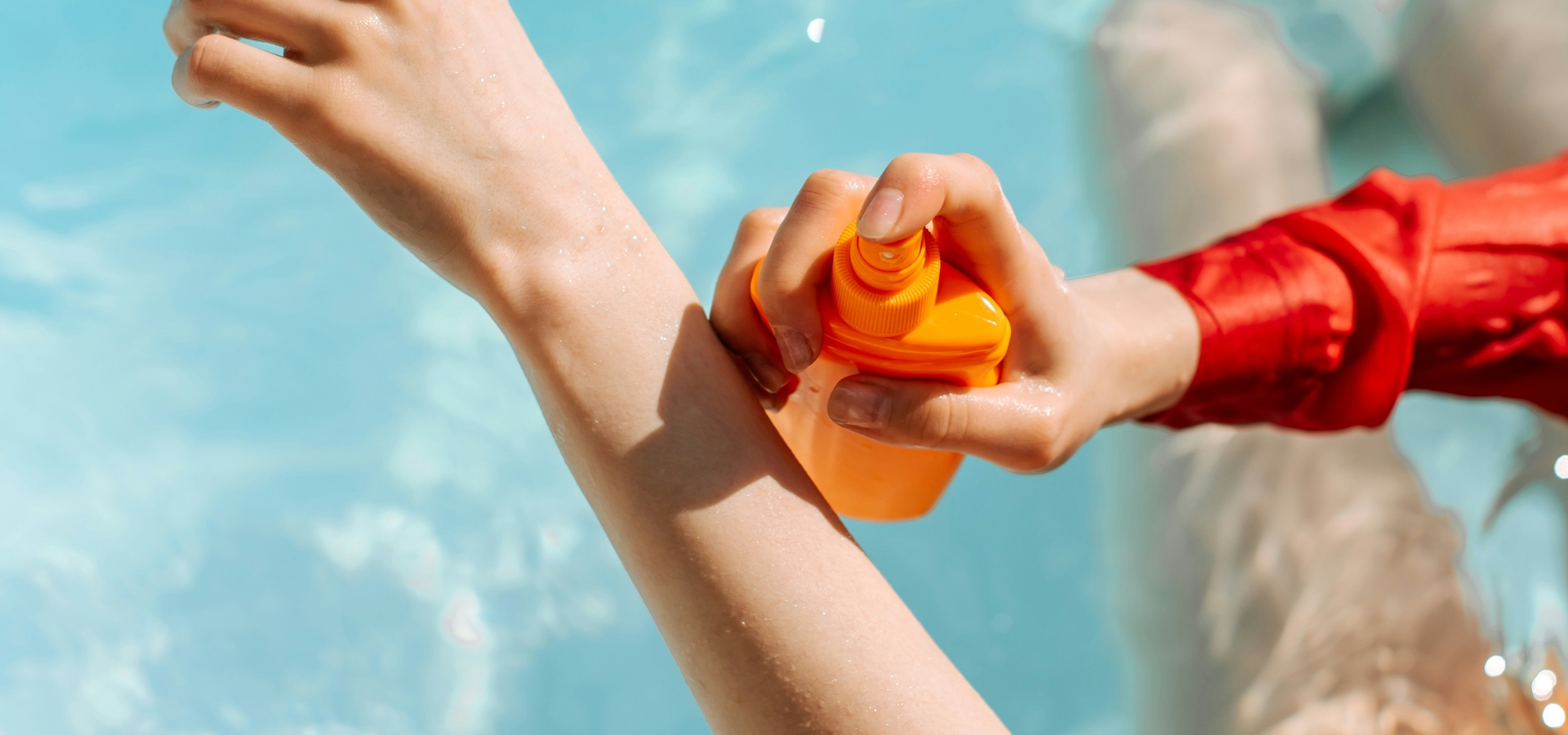
From sunburn to sun safe
Australian researchers pioneered sunscreen science, changing how we protect ourselves from the sun.

Under the harsh Australian sun, a chemist in Adelaide formulated one of the world’s first commercial sunscreens.
The research
Finding ways to protect ourselves from the sun is not new. But from the late 19th century, scientific understanding of the harms of sunburn – and the central role of the sun’s ultraviolet (UV) radiation – was emerging.
In 1928, Australian chemist Milton Blake began research which would lead to the development of one of the world’s first commercial sunscreen products targeting UV radiation.
Blake was inspired by an article in a trade magazine describing a substance called phenyl salicylate, which had the potential to absorb UV rays. He experimented with different formulations to incorporate this substance into a cream base. Working from his boarding house with simple equipment, Blake made many attempts before a formula finally worked.
The formula was later independently verified in a laboratory by Professor Kerr Grant, a physicist at the University of Adelaide confirming it provided UV shielding properties.
The development
In 1932, Blake founded Hamilton Laboratories and began selling ‘Hamilton’s Sunburn Vanishing Cream’. By modern standards, it didn’t provide much protection, equivalent to a Sun Protection Factor (SPF) of about 2.
As sunscreen use expanded, products were refined to give higher UV protection shield against a broader range of ultraviolet wavelengths and remain stable during prolonged exposure to heat and water.
The impact
In the 1970s, two University of Queensland researchers, Dr Gordon Groves and Dr Don Robertson, developed standardised methods to test and compare sunscreens, publishing their rankings in the newspaper every year. Their work, building on the SPF system for rating protection, led to the first Australian regulatory standard for sunscreens in 1986.
Sunscreen has since become a central tool in public health, protecting against not only acute sunburn but also chronic sun-induced skin damage. Randomised trials conducted in Queensland, led by Professor Adele Green, provided the first rigorous evidence that sunscreen can prevent certain skin cancers and slow skin ageing.
From the first tubes to proving its protective power, Australian science is at the heart of the sunscreen story.
Is the next breakthrough at risk?
Breakthroughs like this don’t happen overnight. They are the result of years or decades of discovery research supported by sustained investment.
Australia has fallen significantly behind the OECD average on research and development. Without sustained investment, discoveries like this one will never make it out of the lab.
Email your MP now and ask them to restore investment in Australian science.
Sources
Australian National University. A short history of sunscreen. Centre for Public Awareness of Science. https://cpas.anu.edu.au/news-events/news/short-history-sunscreen
ABC News. Australia’s first sunscreen was invented in Adelaide. 2024. https://www.abc.net.au/news/2024-08-07/australias-first-sunscreen-invented-adelaide-milton-blake/104189256Drissi M, Carr E, Housewright C. Sunscreen: a brief walk through history. Proc (Bayl Univ Med Cent). 2021 Sep 1;35(1):121-123. doi: 10.1080/08998280.2021.1966602. PMID: 34970060; PMCID: PMC8682817. https://pmc.ncbi.nlm.nih.gov/articles/PMC8682817/
Walter S. Milton Blake, sunscreen pioneer. Proc (Bayl Univ Med Cent). 2023 Mar 10;36(3):412-413. doi: 10.1080/08998280.2023.2184159. PMID: 37091756; PMCID: PMC10120514. https://pmc.ncbi.nlm.nih.gov/articles/PMC10120514/
Green A, Williams G, Neale R, Hart V, Leslie D, Parsons P, Marks GC, Gaffney P, Battistutta D, Frost C, Lang C; Russell A. Daily sunscreen application and betacarotene supplementation in prevention of basal-cell and squamous-cell carcinomas of the skin: a randomised controlled trial. The Lancet 1999; 354: 723-29.
Green AC, Williams GM, Logan V, Strutton G. Reduced melanoma after regular sunscreen use: randomized trial follow-up. J Clin Oncol 2011; 29: 257-263.
Hughes MCB, Baker P, Williams GM, Green AC. Sunscreen and prevention of skin aging: a randomized, controlled trial. Annals Int Med 2013; 158: 781-90.
Featured image credit: Kateryna Hliznitsova on Unsplash